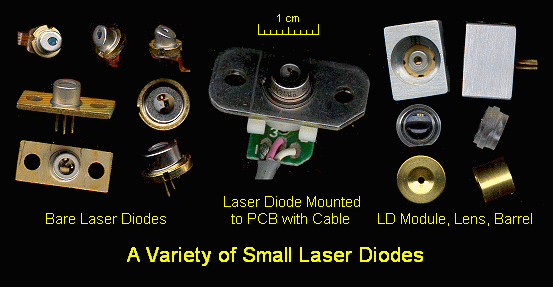
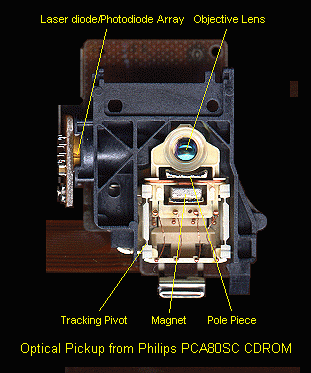
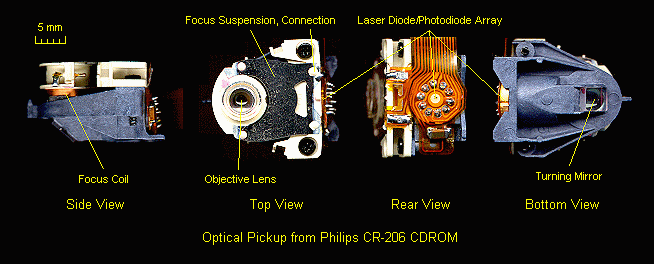
Diode lasers use nearly microscopic chips of Gallium-Arsenide or other exotic semiconductors to generate coherent light in a very small package. The energy level differences between the conduction and valence band electrons in these semiconductors are what provide the mechanism for laser action. This is not the sort of laser you can build from scratch in your basement as the required fabrication technology costs megabucks or more to set up. You will have to be content with powering a commercial laser diode from a home-made driver circuit or using a pre-packaged module like a laser pointer. Fortunately, laser diodes are now quite inexpensive (with prices dropping as you read this) and widely available.
The active element is a solid state device not all that different from an LED. The first of these were developed quite early in the history of lasers but it wasn't until the early 1980s that they became widely available - and their price dropped accordingly. Now, there are a wide variety - some emitting many *watts* of optical power. The most common types found in popular devices like CD players and laser pointers have a maximum output in the 3 to 5 mW range.
A typical configuration for a common low power edge emitting laser diode is shown below:
                          +                                     +
                          o                                     o
            ______________|______________                _______|_______
     Laser |   P type semiconductor      |  Laser       |     P type    |
      beam |                             |  beam        |               |
   <=======|:::::::::::::::::::::::::::::|=======>      |ooooooooooooooo|
           |        Junction---^         |              |               |
     End ->|   N type semiconductor      |<- End        |     N type    |
   facet   |_____________________________|   facet      |_______________|
                          |                                     |
                          o                                     o
                          -                                     -

                     (Side view)                            (End view)

          |<----------------------- 1 mm ------------------------>|
This configuration above is called a 'homojunction' since there is only one
P-N junction. It turns out there are benefits to using several closely spaced
junctions formed by the use of layers of P and N type materials. These are
called 'heterojunction' laser diodes. There are many many more advanced
structures in use today and new ones are being developed as you read this!
For example, see the section: Vertical Cavity
Surface Emitting Laser Diodes (VCSELs) for a description of one type that
has the potential to have a dramatic impact in many areas of technology.
The 'end facets' are the mirrors that form the diode laser's resonant cavity. These may just be the cleaved surfaces of the semiconductor crystal or may be optically ground, polished, and coated.
Electrical input to the laser diode may be provided by a special current controlled DC power supply or from a driver which may modulate or pulse it at potentially very high data rates for use in fiber optic or free-space communications. Multi-GHz transmission bandwidth is possible using readily available integrated driver chips.
However, unlike LEDs, laser diodes require much greater care in their drive electronics or else they *will* die - instantly. There is a maximum current which must not be exceeded for even a microsecond - and this depends on the particular device as well as junction temperature. In other words, it is not sufficient in most cases to look up the specifications in a databook and just use a constant current power supply. This sensitivity to overcurrent is due to the very large amount of positive feedback which is present when the laser diode is lasing. Damage to the end facets (mirrors) can occur very nearly instantaneously from the concentrated E/M fields in the laser beam. Closed loop regulation using optical feedback to stabilize beam power is usually implemented to compensate for device and temperature variations. See the sections on CD and visible laser diodes later in this document before attempting to power or even handle them. Not all devices appear to be equally sensitive to minor abuse but it pays to err on the side of caution (from the points of view of both your pocketbook and ego!).
In their favor, laser diodes are very compact - the active element is about the size of a grain of sand, low power (and low voltage), relatively efficient (especially compared to the gas lasers they replaced), rugged, and long lived if treated properly.
They do have some disadvantages in addition to the critical drive requirements. Optical performance is usually not equal to that of other laser types. In particular, the coherence length and monochromicity of many types are likely to be inferior. This is not surprising considering that the laser cavity is a fraction of a mm in length formed by the junction of the III-V semiconductor between cleaved faces. Compare this to even the smallest common HeNe laser tubes with about a 10 cm cavity. Thus, these laser diodes would not be suitable light sources for holography or long baseline interferometry.
However, for many applications, laser diodes are perfectly adequate and their advantages - especially small size, low power, and low cost - far outweigh any faults. In fact, these 'faults' can prove to be advantageous where the laser diode is being used simply as an illumination source as unwanted speckle and interference effects are greatly reduced.
As noted, not all laser diodes have the same performance. See the section: Interferometers Using Inexpensive Laser Diodes for comments that suggest some common types have beam characteristics comparable to typical HeNe lasers.
The following sites provide some relatively easy to follow discussions of the principles of operation, construction, characteristics, and other aspects of laser diode technology:
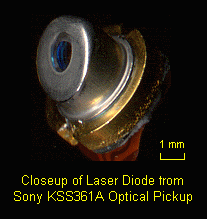
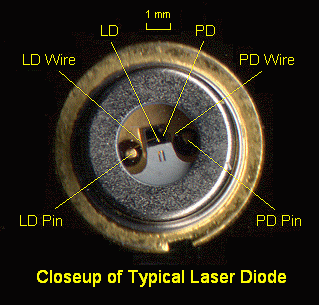
The closeups below were scanned at 600 dpi - laser diodes (at least the small ones we are dealing with) are really not this HUGE! These two laser diodes can also be found in the group photo, above.
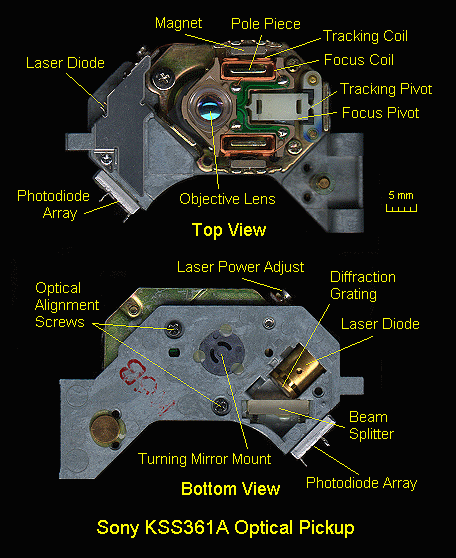
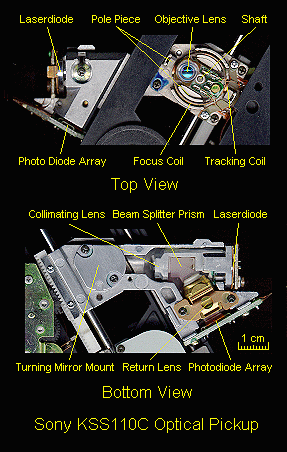
The Closeup of laser diode from the Sony KSS361A Optical Pickup shows a type that is found in many CD players and CDROM drives manufactured by Sony. The actual laser diode is inside the brass barrel shown in the photo of the optical pickup. The front of the package is angled so that the exit window (anti-reflection coated) is also mounted at what may be the Brewster angle, probably to further prevent stray reflections from the window's surfaces from feeding back into the laser diode's cavity or interfering with the detected signal. (At the Brewster angle, light polarized parallel to the window is totally reflected and light polarized perpendicular to it is totally transmitted. The output of these edge emitting laser diodes is polarized. See the section: What is a Brewster window?.)
The Closeup of Typical Laser Diode shows one that is from a laser printer. It was mounted in a massive module (relative to the size of this laser diode, at least) which included the objective lens and provided the very important heat sink. In some high performance laser printers, a solid state Peltier cooler is used to stabilize the temperature of the laser diode. The low power laser diodes in CD and LD players, and CDROM and other optical drives (at least read-only types) get away with at most, the heat sink provided by the casting of the optical block - and many don't even need this being of all plastic construction.
One can think of an LED as a laser without a feedback cavity. The LED emits photons from recombining electrons. It has a very broad spectrum.
When we add a high Q cavity to it, the feedback can be high enough to trigger true laser action. Most laser diodes have the cavity built right into the device but there are such things as external cavity diode lasers.
The addition of the high Q cavity cuts down drastically the number of modes operating (in fact, it is almost improper to speak of mode structure with an LED. The result is that the emission line narrows drastically (more monochromatic) and the beam narrows somewhat spatially. One can still not easily get true single mode lasing with normal diode lasers, however, so the line will not be as sharp as a gas laser, nor the beam as narrow.
(From: Don Stauffer (stauffer@htc.honeywell.com)).
Yes indeed, a diode laser is a true laser. That being said, looking at matters quantitatively, it is harder to make a diode laser with a very narrow line emission than a gas laser or large crystal laser. Adding cavity length to a laser in general acts to narrow the line (in spectral space, though a higher Q cavity does tend to narrow beam in space also). It is possible to use a larger, high Q external cavity with a laser diode to increase its coherence.
(From: David Schaafsma (drdave@jnpcs.com) and Rajiv Agarwal (agarca@giascl01.vsnl.net.in)).
A couple of minor points:
High Q cavities narrow the spatial profile only if they are confocal - planar high Q cavities (as in diode lasers, and especially vertical-cavity diode lasers) are prone to problems with walk-off and the mode must be confined physically.
In a gas laser, you also start with a much narrower fluorescence line and thus the gain spectrum is limited spectrally. Diode lasers (being band-to-band or excitonic semiconductor transitions) have much broader fluorescence spectra.
The typical edge-emitting diode laser actually lases in quite a few fundamental modes (especially when operated using its own facets as the cavity) and though each lasing mode is "monochromatic", the overall spectrum really isn't. External cavities are really the only way to obtain approximately single mode operation from an edge-emitting diode laser.
VCSELs are usually true single mode devices. The reason you can get away with lengthening the cavity in a gas laser is that you don't need to worry about lowering the free spectral range because the gain bandwidth is small.
DFB or DBR lasers achieve very similar results and have Side mode suppression ratios better than 30 db. These lasers have been the mainstay of Optical fiber base telecom for a while now.
DFB Lasers are use for long haul telecommunications network - the kind used by say Sprint (>1GB for up to 25 miles) for their phone networks between cities. These have been for Trans-Atlantic cables (TAT) between US and Europe. LEDs are used more for FDDI type application between computers (~100Mb and less than 1 mile).
(From: Vishwa Narayan (vishwa.narayan@ericsson.com)).
While LEDs are quite popular in Datacom applications (read short distances), Telecom applications typically use DFBs, either directly modulated for low speeds (e.g., OC-3 155 Mb/sec) or externally modulated for high speeds (e.g., OC-48 2.5 Gb/sec). Distances can typically range over tens of kilometers, to hundreds of kilometers with optical amplification, sans repeaters.
One should never look into the beam of any laser - especially if it is collimated. Use an indirect means of determining proper operation such as projecting the beam onto a white card, using an IR detector card or tester (where needed), or laser power meter.
See: NRPB Is1-98 for a discussion of some of the specific safety risks, myths, and concerns with respect to laser pointers.
(From: Gregory Makhov (lsdi@gate.net)).
According to a recent report by Dr. David Sliney, who is one of the leading "gurus" of laser safety, there are no confirmed accidents or injuries caused by laser pointer of 5 milliwatts radiant power or less. There is an awful lot of nonsense and false claims about this. Pointers are extremely bright, can cause visual distraction, afterimages, and other effects, such as headaches, but under most any typical usage condition, DO NOT cause eye injury. Dr. Sliney works for US Army, and has published papers and books on laser safety for over 20 years.
For IR laser diodes in particular, especially if you are considering selling a product:
(Portions from: Steve Roberts (osteven@akrobiz.com)).
You need to take a close look at the CDRH rules, because there is no blink reflex in the IR. IR diode lasers are considered much more dangerous and therefore are in a higher class. CDRH has a curve of power versus wavelength that is used for determining safety classes. The only way a IR laser gets less then a IIIb rating (read: dangerous) is if the beam is totally enclosed or of very low power. Go to CDRH, call them and request a manufacturers' packet by mail. It's huge and confusing, but covers the requirements for products using IR laser diodes such as 3-D scanners, perimeter sensors, and so forth.
Visible laser diodes have replaced helium-neon lasers in supermarket checkout UPC scanners and other bar code scanners, laser pointers, patient positioning devices in medicine (i.e., CT and MRI scanners, radiation treatment planning systems), and many other applications. The first visible laser diodes emitted at a wavelength of around 670 nm in the deep red part of the spectrum. More recently, 650 nm and 635 nm red laser diodes have dropped in price.
Due to the nonuniformity of the human eye's response, light at 635 nm appears more than 4 times brighter than the same power at 670 nm. Thus, the newest laser pointers and other devices benefitting from visibility are using these newer technology devices. Currently, they are substantially more expensive than those emitting at 670 nm but that will change as DVDs become popular:
Laser diodes in the 635 to 650 nm range will be used in the much hyped DVD (Digital Video - or Versatile - Disc) technology, destined to replace CDs and CDROMs in the next few years. The shorter wavelength compared to 780 nm is one of several improvements that enable DVDs to store about 8 times (or more - 4 to 5 GB per layer, the specifications allow up to 2 layers on each side of a CD-size disc!) the amount of information or video/audio as CDs (650 MB). A side benefit is that dead DVD players and DVDROM drives (I cannot wait) will yield very nice visible laser diodes for the experimenter. :-)
Like their IR cousins, the typical maximum power from these devices is around 3 to 5 mW. Cost is in the $10 to $50 for the basic laser diode device - more with optics and drive electronics. Higher power types (10s of mW) are also available but expect to spend several hundred dollars for something like a 20 mW module. Very high power diode lasers using arrays of laser diodes or laser diode bars with power output of WATTs or greater may cost 10s of thousands of dollars!
                ___
               |   |          Metal case
               |   |_______________________________
               |                                   \
               |    _____________________________   |
               |   |                             |  |
     LD -------:===:------------------+          |  |
               |   |__                |          |__|
               |   |  |___      ______|______    :  :
               |   |  |   |    |             |   :  :
     PD -------:===:----+ |<---|:::::::::::::|============> Main beam
               |   |  |___|____|_____________|_  :  :          (divergent)
               |   | Photodiode  Laser diode   | :__:
               |   |\__________________________| |  | Protective window
    Com -------+   |          Heat sink          |  |
               |   |_____________________________|  |
               |                                    |
               |    _______________________________/
               |   |
               |___|
The main beam as it emerges from the laser diode is wedge shaped and highly
divergent (unlike a helium-neon laser) with a typical spread of 10 by 30
degrees. External optics are required to produce anything approaching a
parallel (collimated) beam. A simple (spherical) short focal length convex
lens will work reasonably well for this purpose but diode laser modules and
laser pointers might use a lens where at least one surface is aspheric (not
ground to a spherical shape as are with most common lenses).
In the case of a sample I removed from a dead diode laser module, the surface facing the laser diode was slightly curved and aspheric while the other surface was highly curved and spherical. The effective focal length of the lens was about 5 mm. It appeared similar to the objective lens of a CD player - which was perhaps its original intended application and thus a low cost source for such optics.
Due to the nature of the emitting junction which results in a wedge shaped beam and unequal divergence (10 x 30 degrees typical), a laser diode is somewhat astigmatic. In effect, the focal length required to collimate the beam in X and Y differs very slightly. Thus, an additional cylindrical lens or a single lens with an astigmatic curvature is required to fully compensate for this characteristic. However, the amount of astigmatism is usually small and can often be ignored. The general beam shape is elliptical or rectangular but this can be circularized by a pair of prism. The light from these edge emitting laser diodes is generally linearly polarized.
For addition information, see the section: Beam Characteristics of Laser Diodes.
The beam from the back end of the laser diode chip hits a built-in photodiode which is normally used in an opto-electronic feedback loop to regulate current and thus beam power. Note that the photodiode is likely mounted at an angle (not possible to show in ASCII) so that the reflection does not interfere with the operation of the laser diode.
CAUTION: Some complete modules may use the reflection from external optics along with an external photodiode for power stabilization as it is more accurate since the actual output beam is sampled. For these, one should never attempt to clean or even focus the lens when operating near full power as this may disturb the feedback loop and damage the laser diode.
The good news is that this technology is developing very rapidly.
The bad news from our perspective is that there are no surplus (read: low cost) sources for these diode lasers as far as I know at the present time. New ones are still pretty expensive.
For example, a 1 W diode is currently (Summer 1998) $425 in the MWK Industries catalog!
You can imagine what a NEW 50 W rig would go for!
Note that most of these high power diode lasers are near IR - often around 800 nm for pumping DPSS lasers and optical communications. High power visible laser diodes are much less common and usually limited to less than a W at 670 nm.
If you have your heart set on one of these for your birthday, all I can suggest at the present time is to keep track of what is available surplus and to check with the manufacturers listed in the chapter: Laser and Parts Sources. If this is for some sort of academic project with a legitimate research objective, you may be able to obtain a cosmetic reject or one that doesn't quite meet specs by persistent pleading with one of the laser diode manufacturers. But, the rest of us will just have to be patient and wait for the prices to come down.
Keep in mind that obtaining the diode is only a small part of the problem. These devices are exceeding fussy about drive and cooling - even much more so than the wimpy little laser diodes found in CD players and laser pointers!
And, needless to say, at these power levels, your eyes (and flammable objects) don't get a second chance - laser safety must be at the top of your list of priorities.
VCSELs, on the other hand, emit their beam from their top surface (and potentially bottom surface as well). The cavity is formed of a hundred or more layers consisting of mirrors and active laser semiconductor all formed epitaxially on a bulk (inactive) substrate.
This approach provides several very significant technical advantages:
The beam from a typical VCSEL exits from a circular region 5 to 25 um in diameter. Since this is much larger than for the FP laser diode, the divergence of the resulting beam is much lower. And, because it is also circular, no corrections for asymmetry and astigmatism are required - a simple lens should be able to provide excellent collimation.
On the other hand, an entire wafer of VCSELs can be tested as a unit with each device evaluated for lasing threshold and power, and beam shape, quality, and stability, It is possible to form millions of VCSELs on a single wafer as a batch process and then test and evaluate the performance of each one automatically. The entire wafer can be burned in to eliminate infant mortalities and assure higher reliability of the final product. Each device can then be packaged or thrown away based on these findings.
However, neither of these devices is designed to be modulated at any more than a couple of Hz (if that) due to the heavy internal filtering to protect the laser diode from power spikes. Therefore, they are generally unsuitable for laser communications applications (though some laser pointers are so cheaply designed that such protection may be absent entirely).
Common visible laser diodes have a maximum optical output power of 3 to 5 mW. Due to the sensitivity curve of the human eye, a wavelength of 635 nm appears at least 4 times brighter than an equivalent power level at 670 nm. Thus, shorter wavelength laser diodes will be best where maximum visibility is important. However, these are currently much more expensive - but this will change as DVD technology takes off.
Where the use of a diode laser module or laser pointer is suitable for your application, I would highly recommend this over attempting to cobble together something from a bare laser diode and homemade power supply - or even a commercial driver if it isn't explicitly designed for your particular laser diode. It really is all too easy to fry expensive laser diodes through improper drive or handling. Once blown, laser diodes don't even work very well as visible LEDs!
See the chapter: Laser Parts Sources for a number of suppliers of both diode laser modules and laser pointers. In additiona, Don's Klipstein (don@misty.com) maintains a Web page with a List of Suppliers of Inexpensive Lasers. While not exhaustive, it does include some popular distributors and he does strive to keep it reasonably up to date. Some of these companies now sell laser pointers for under $10!
However, there is no way to know how reliable or robust an inexpensive laser pointer will be - or if the beam quality is acceptable before purchase. Diode laser modules are generally more expensive and of higher quality (though not always) so they may be a better bet for serious applications. Also consider a helium-neon laser since even the cheapest type is likely to generate a beam with better beam quality than the typical diode laser or laser pointer. While any Tom, Dick, or Harry, can put together a laser pointer of questionable design from readily available parts and sell it on the Internet, only a handful of companies manufacturer HeNe tubes and they are all of pretty high quaity. See the chapter: Helium-Neon Lasers for more information.
The simple answer is: it all depends. There can be variability in any type of product. While the desired output of a laser pointer and collimated diode laser module is similar, how fussy the end-user is and how one gets there may not be:
As far as I know, CDRH approval will not be granted for any device of this type over 5 mW actual beam power since their classification would then need to be IIIb. So, don't expect to find a laser diode with an actual output power of 30 mW in anything like a laser pointer! Frankly, I don't understand how laser pointers with an output above 1 mW gain approval in any case. The 670 nm pointers especially (since they APPEAR less bright) represent a definite hazard to vision at close range. Do not underestimate the stupidity of some people who totally ignore all the safety warnings - "Wow, look at these cool afterimages." - and then wonder why their vision never quite returns to normal.
Another popular 'specification' is how far away the laser pointer is visible. What the seller is probably actually referring to is the distance that their Marketing department *thinks* the beam should be visible so long as this value is greater than that of their competition. :-)
Seriously, who knows? There is no standards organization overseeing these ratings. It could be the maximum distance to the screen that the beam is visible:
Laser pointer marketers don't appear to have discovered (3) as yet since the number would be extremely impressive - being in the many miles range!
CAUTION: Some diode laser modules are current controlled using optical feedback but expect a regulated DC power supply input. With these, the output will continue to increase more or less linearly as the input is cranked up until the point at which the smoke comes out :-(.
I know that in your fantasies, you have dreamed about the possibility of creating a burning laser or Star Wars style light saber from a laser pointer. Unfortunately, neither of these is even possible theoretically. The best you could ever hope for would be to obtain at most 5 mW from a device currently outputting 2 or 3 mW.
While it might be feasible to increase the current to the laser diode, unless you know its specifications AND have an accurate laser power meter (mucho $$$), there is no way of knowing when to quit. Above their rated maximum optical power, laser diodes turn into DELDs (Dark Emitting Laser Diodes) or expensive LEDs. Exceed this rating for even a microsecond and your whimpy 3 mW output may be boosted to precisely 0.0 mW. However, if you have a bag of these gadgets and are willing to blow a few, here are some guidelines:
This really IS like playing Russian Roulette and my serious recommendation would be to leave well enough alone. Save for a more powerful unit or even just a 635 nm laser pointer if your current model is 670 nm (which will appear at least 5 times brighter for the same output power).
Also see the section: Determining Characteristics and Testing Low Power Laser Diodes.
The quick answer is a definite maybe IFF the module or pointer can be opened for examination or repair. If it is a potted block, forget it.
The chances of success are much greater for a diode laser module since it is likely to have a proper laser diode driver with current regulation and optical feedback. These are typically so over-designed that while applying excessive voltage (well, within reason, not 120 VAC to a 5 VDC module!) or incorrect polarity may blow some components, chances are that the laser diode itself won't feel a thing and will survive unharmed.
Assuming you can get inside, repair should be possible. And, even if you end up having to replace a 5 mW laser diode (for, perhaps $10), you have made out well. High quality diode laser modules go for anywhere from $50 to $300.
However, depending on design, a laser pointer could be totally destroyed by even modest overvoltage (say 5 V instead of 3 V from 2 AAA batteries) or reverse polarity. Some of these don't have anything more than a resistor for current limiting. So the laser diode could very well have been damaged or turned into a DELD (Dark Emitting Laser Diode) or expensive LED. All you may end up with is a nice (or not so nice) case. :-( Of course that in itself may come in handy to package your own laser diode and driver - ignoring what was originally there.
There are at least 3 surfaces that can collect dirt - the two sides of the lens (it is probably a single element) and the exterior of the laser diode window. However, in all likelihood, only the exposed surface of the lens will need cleaning.
First, gently blow out any dust or dirt which may have collected inside the lens assembly. A photographic type of air bulb is fine but be extremely careful using any kind of compressed air source. Next, clean the lens itself. It may be made of plastic, so don't use strong solvents. There are special cleaners, but isopropyl alcohol usually is all that is needed. 91% medicinal should be fine, pure isopropyl is better. Avoid rubbing alcohol especially if it contains any additives.
Lens tissue is best, Q-tips (cotton swabs) will work. They should be wet but not dripping. Be gentle - the plastic (probably) or glass and particularly the anti-reflection coating on lens is soft. Wipe in one direction only - do not rub. Also, do not dip the tissue or swab back into the bottle of alcohol after cleaning the optics as this may contaminate it.
The alcohol should be all you need in most cases but some types of dirt (e.g., sugar) will respond better to just plain water.
The inside surface of the lens, any other optics, and the window of the laser diode can be cleaned in a similar manner should this be necessary. Usually, it is not.
Do NOT use strong solvents (which may attack plastic lenses) or anything with abrasives - you will destroy the optics surfaces.
CAUTION: Lenses or other optical components may be bonded or mounted using adhesives that are soluble in alcohol or acetone (but probably not water). Don't make the mistake I made and use too much solvent. I still have not found the tiny collimating lens that popped out of a laser diode module and is now likely lost forever to the basement floor. Crunch :-(.
This is one reason why most applications of laser diodes include optical sensing to regulate beam power. The third lead on the laser diode package is connected to an internal optical sensing photodiode used to regulate power output when used in a feedback circuit which controls your current. This is very important to achieve any sort of stable long term operation.
You can easily destroy a laser diode by exceeding the safe current even for an instant. It is critical to the life of the laser diode that under no circumstances do you exceed the safe current limit even for a microsecond!
In addition, as the temperature of the laser diode changes (heats while powered), the current requirement to produce a given optical output increases as well. Without optical feedback if you set the current to be correct once the temperature of the laser diode stabilizes, it will likely blow out instantly the next you turn it on from a cold start!
Laser diodes are also extremely static sensitive, so take appropriate precautions when handling and soldering. Also, do not try to test them with an analog VOM which could on the low ohms scale supply too much current.
It is possible to drive laser diodes with a DC supply and resistor, but unless you know the precise value needed or have a laser power meter at your disposal, you can easily exceed the ratings before you realize it.
You might hear someone bragging "I have driven thousands of laser diodes by just connecting them to a battery and resistor and never have blown any". Sure, right. While it is quite possible that the susceptibility to instant damage due to overcurrent varies with the type of laser diode, unless you know the precise behavior, you must err on the side of caution. Some designers have gone to extremes, however. See the section: Laser Diode Power Supply 2 (RE-LD2) for a design with 5 levels of protection!
For testing, see the section: Testing of Low Power Laser Diodes.
For an actual application, you should use the optical feedback to regulate beam power. You should also use a heatsink if you do not already have the laser diode mounted on one. See the chapter: Laser Diode Power Supplies.
The raw beam from a laser diode is generally wedge shaped - 10 x 30 degrees is a typical divergence. You will need a short focal length convex lens to produce anything approaching a collimated beam. The optics from a dead CD player (even though CD players and CDROM drives use infra-red laser diodes, the optics can likely still be used with visible laser diodes), a low to medium power microscope objective, or even an old disc camera can provide a lens that may be entirely suitable for your needs.
Thus, these devices make truly lousy laser pointers or laser light shows as the emission is just barely visible in subdued light. If you hoped for a Star Wars type laser beam, better go hunting for a 25W argon laser. :-)
However, for data or voice communications, various kinds of scanning or sensing, and electro-optic applications where visibility is not needed or not desirable, such low cost sources of coherent light are ideal.
Similar types are found in CDROM drives and newer LD (LaserDisc) players. CD-R recorders, Minidisc equipment, magneto-optical, and other writable optical drives including WORM drives, use devices that are similar in appearance and drive requirements but may be capable of somewhat higher maximum power output - as much as 30 mW or more.
Modern laser printers use laser diodes producing anywhere from 5 mW to 50 mW and beyond depending on their resolution and speed (pages per minute). High resolution laser imagers, typesetters, and plotters, may use laser diodes producing 150 mW or more. (However, equipment built before 1985 or so may use helium-neon or even argon lasers rather than diode lasers.)
The laser diode in a laser printer is located inside the scanner unit which is probably a black plastic case about 6 or 8 inches on a side and a couple of inches thick with a motor protruding from the bottom. The laser diode is mounted (along with its driver board, collimating optics, and even possibly a Peltier solid state cooler on some) either near one corner or inside. There should be a laser safety sticker on it as well - but these fall off sometimes!
It is essential that additional precautions are taken if you have a higher power laser diode from equipment of this sort (or don't really know where yours spent its earlier life).
There are now laser diodes (or possibly laser diode arrays) with optical output measured in 10s, even 100s of watts though these will not be what you would call tiny and will probably require buss bars for electrical power and plumbing for cooling!
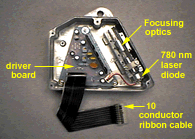
This Laser Printer Diode Laser Module is from an older unidentified laser printer, laser scanner/duplicator, or similar device. It shows an example of a typical assembly consisting of an IR laser diode, collimating optics, and electronics driver board.
CD player laser diodes are infrared (IR) emitters, usually 780 nm, with a maximum power output of around 5 mW. There is also a very slightly visible deep red emission from all those I have seen. This may be a spurious very low power line in the red part of the spectrum or your eye's response to the near IR appearing red and about 10,000 times weaker than the actual beam. Despite what the EM spectrum charts show, the eye's response does not drop off to zero at exactly 700 nm so there decreasing sensitivity out to 800 nm or beyond depending on the individual. The main beam is IR and invisible. Take care. A collimated 5 mW beam is potentially hazardous to your eyes. Don't be misled into thinking the laser is weak due to the weak appearance of the beam. It is not supposed to be visible at all!
Typical CD laser optics put out about .3-1 mW at the objective lens though the diodes themselves may be capable of up to 4 or 5 mW depending on type. If you saved the optical components, these may be useful in generating a collimated or focused beam. The aspheric objective lens will be optimized for producing a diffraction limited spot about 1 to 3 mm from its front surface when the optical system is used intact.
The optics may include a collimating lens, diffraction grating (to produce the three beams in a three beam pickup), beam splitter prism or mirror, turning mirror (for horizontally mounted optics), and focusing (objective) lens. Older pickups tend to have larger and more complex sets of optics. Despite the fact that they are mass produced at low cost, these are all very high quality optical assemblies.
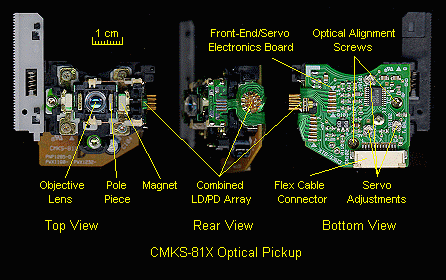
However, depending on design, some of the parts may be missing or combined into one component. For example, many Sony pickups do not appear to use a collimating lens. For pickups with a collimating lens, if the objective lens is removed, you should get a more or less parallel main beam and two weaker side beams. Many newer designs have a combined laser diode/photodiode array rather than individual components. Mix and match parts for your needs (if you can get it apart non-destructively). Where there is no collimating lens, the objective lens may be used for this purpose if positioned closer to the laser diode.
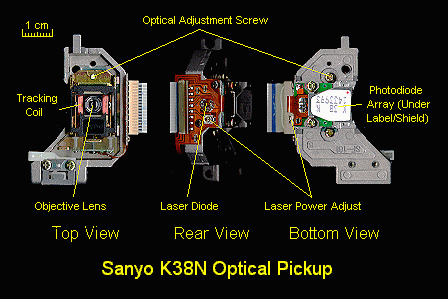
For examples of typical optical pickup/optical block designs, see:
The coils around the pickup are used for servo control of focus and tracking by positioning the objective lens to within less than a um (1/25,400 of an inch) of optimal based on the return beam reflected from the CD. See the document: Notes on the Troubleshooting and Repair of Compact Disc Players and CDROM Drives for more information on optical pickup organization and operation.
Typical drive currents are in the 30 to 100 mA range at 1.7 to 2.5 V. However, the power curve is quite non-linear (though perhaps not as extreme as the typical visible laser diode). There is a lasing threshold below which there will be no coherent output (just IR LED emission). For a diode rated at a nominal current of 50 mA (typical for Sony pickups, for example), the threshold current may be 30 mA. This is one reason why most applications of laser diodes include optical sensing (there is a built in photodiode in the same case as the laser emitter) to regulate beam power. You can easily destroy a laser diode by exceeding the safe current even for an instant. It is critical to the life of the laser diode that under no circumstances do you exceed the safe current limit even for a microsecond!
Laser diodes are also supposed to be extremely static sensitive, so use appropriate precautions. Also, do not try to test them with an analog VOM which in particular could on the low ohms scale supply too much current.
It is possible to drive laser diodes with a DC supply and resistor, but unless you know the precise value needed, you can easily exceed the ratings.
For testing, see the section: Testing of Low Power Laser Diodes.
For an actual application, you should use the optical feedback to regulate beam power. You should also use a heatsink if you do not already have the laser diode mounted on one. CD laser diodes are designed for continuous operation. See the chapter: Laser Diode Power Supplies.
Caution: Removing the laser diode from the optical assembly may affect critical optical alignment since it will not be possible to replace it in precisely the same position. This probably doesn't matter for most purposes but is something to keep in mind if you intend to use the device in a manner similar to its original applications. See the section: Reasons to Leave the CD Laser Diode in the Optical Block.
Note that if you have a device from a CD player, CDROM, or other optical drive with 8 or 10 pins, it is a combined laser diode and photodiode array in a single package. You will first have to identify the three connections to the laser diode itself. You should be able to determine this by tracing the wiring - there may even be markings on the circuit board. In many cases, the laser diode is driven by discrete components whereas everything else goes to a preamp IC. Once the pinout of the laser diode is determined, it can be treated in exactly the same way as the more common 3 pin type.
The first step is to identify which pair of terminals are the laser diode and photodiode. Your laser diode package will be configured like one of the following:
            LD                 LD                 LD                 LD
         +--|>|--o LDC      +--|>|--o LDC      +--|<|--o LDA      +--|<|--o LDA
         |                  |                  |                  |
  COM o--+           COM o--+           COM o--+           COM o--+
         |  PD              |  PD              |  PD              |  PD
         +--|>|--o PDC      +--|<|--o PDA      +--|>|--o PDC      +--|<|--o PDA
            (1)                (2)                (3)                (4)
The most common polarities for low power laser diodes seems to be (2). The COM
terminal will then be connected to a positive supply (+V) relative to LDC and
PDA.
Where you can see both the pins and the inside of the laser diode package, it is easy to identify which pins goes where:
* The connection to the photodiode (PD) will attach via a fine wire to the photodiode chip mounted (probably at a slight angle) deep inside the package.
The following assumes you did not have this luxury:
The photodiode's forward voltage drop will be in the approximately .7 V range compared to 1.7-2.5 V for the laser diode. So, for the test below if you get a forward voltage drop of under a volt, you are on the photodiode leads. If your voltage goes above 3 V, you have the polarity backwards.
CAUTION: Some laser diodes have very low reverse voltage ratings (e.g., 2 V) and will be destroyed by modest reverse voltage. Check your spec sheet. However, the laser diodes found in CD players seem to be happy with 4 or 5 volts applied in reverse. Of course, a shorted or open reading could indicate a defective laser diode or photodiode.
If the laser diode is still connected to its circuitry (probably a printed flex cable), it is likely that the laser diode will have a small capacitor directly across its terminals and the optical sensing photodiode will be connected to a resistor or potentiometer. In particular, this is true of Sony pickups and may help to identify the correct hookup.
             R1 100 ohms 1 W
       + o--------/\/\--------+-----------+--------+
                              |           |        |
    Power supply        C2 + _|_      C2 _|_     __|__ LD1
    0 to 10 VDC        10uF  ---   .01uF ---     _\_/_ Laser diode
   (No overshoot!)         -  |           |        |
                              |           |        |
       - o--------------------+-----------+--------+
If your power supply has a current limiter, set it at 50 or 60 mA to start.
You can always increase it later.
                             R2 100 1W
       + o-----------+     +----/\/\------+-----------+--------+
                     |     |              |           |        |
       10VDC         / ^   |         C1 +_|_      C2 _|_     __|__ LD1
    Power supply     \<----+ R1     10uF ---   .01uF ---     _\_/_ Laser diode
   (No overshoot!)   / 100 ohms         - |           |        |
                     | 2W                 |           |        |
       - o-----------+--------------------+-----------+--------+
R2 limits the maximum current. If you know the specs for your diode, this
is a good idea (and to protect your power supply as well). You can always
reduce its value if your laser diode requires more than about 85 mA (with
R2 = 100 ohms).
Before attempting to obtain lasing action with either of these circuits, monitor the voltage across what you think is the laser diode as you slowly increase the power supply or potentiometer.
    Wavelength        Operating Current
  ---------------------------------------
      808 nm             60 - 70 mA
      780 nm             45 - 55 mA
      670 nm             30 - 35 mA
      660 nm             55 - 65 mA
      650 nm             65 - 85 mA
      640 nm             70 - 90 mA
Of course, if you inherited a bag of identical laser diodes and can afford to
blow one: (1) I could use a few before you do this :-) and (2) you probably
could fairly accurately characterize them by testing one to destruction.
For a current below the lasing threshold for your laser diode, there will be some emission due to simple LED action. As you slowly increase the current, at some point (if the laser diode is good) as you exceed the threshold current, the character of the emission will change dramatically and a very slight increase in laser diode current will result in a significant increase in intensity. Congratulations! The laser diode is lasing.
CAUTION: unless you have a laser power meter, don't push your luck. The maximum safe current may be as little as 5% above the lasing threshold. Go over by 6% and your diode may be history. The exponential power curve seems to be steeper with visible laser diodes but there is no way to be sure without specifications. It is all too easy to convert laser diodes into extremely useless DELDs (Dark Emitting Laser Diodes) or very expensive LEDs.
I have used this approach with laser diodes from dead CD players without difficulty. In the case of many of these, the operating current is printed on a sticker on the optical block, often as a 3 digit number representing the current in 10ths of mAs. Typical values are 35 to 60 mA (350 to 600). Sony pickups typically average around 50 mA. Without this information, the best you can do is to estimate when it is lasing at the proper intensity by comparing the brightness of the 'red dot' one sees by looking into the lens from a safe distance at an oblique angle. However, this is not very reliable as the optical power at the objective lens depends on the particular CD player.
If you are trying to use a video camera or camcorder as an IR detector, confirm its sensitivity to near IR by looking at an active IR remote control through its viewfinder. It may have a built in IR blocking filter which will prevent it from being sensitive to IR. This may be removable.
Component values are not critical. Purchase photodiode sensitive to near IR (750-900 um) or salvage from opto-coupler or photosensor. Dead computer mice, not the furry kind, usually contain IR sensitive photodiodes. For convenience, use a 9V battery for power. Even a weak one will work fine. Construct so that LED does not illuminate the photodiode!
The detected signal may be monitored across the transistor with an oscilloscope.
 Vcc (+9 V) o-------+---------+
                    |         |
                    |         \
                    /         /  R3
                    \ R1      \  500
                    / 3.3K    /
                    \       __|__
                    |       _\_/_  LED1 Visible LED
                  __|__       |
        IR ---->  _/_\_ PD1   +--------o Scope monitor point
          Sensor    |         |
        Photodiode  |     B |/ C
                    +-------|    Q1 2N3904
                    |       |\ E
                    \         |
                    / R2      +--------o GND
                    \ 27K     |
                    /         |
                    |         |
       GND o--------+---------+
                   _|_
                    -
Having analyzed the circuit in the section: Laser Diode Power Supply 4 (RE-LD4), I then proceeded to try out a variety of typical visible laser diodes. For all the undamaged laser diodes that I tested, leaving SBT open resulted in safe feedback regulated operation at Vcc1 = Vcc2 = 7 V. But, depending on the particular sample's photodiode sensitivity, optical output power varied widely.
While testing, I used a regulated power supply with adjustable current limit. The voltage was set at 7 V and the current limit knob was used to ramp up the input to the driver while monitoring laser diode current and/or feedback voltage from the photodiode. This approach may have prevented damage to a laser diode on more than one occasion.
          Sample    SBT     LD Current     LD Power Output
        ----------------------------------------------------
          1 (49)    Open       79 mA            .3 mW
                    39K        80 mA            .5 mW
                    12K        82 mA           1.2 mW

          2 (H81)   Open      104 mA           1.5 mW

          3 (H74)   Open       80 mA           2.0 mW

          4 (21)*   Open     >150 mA            .3 mW

          5 (696)   Open       67 mA            .2 mW
                    39K        69 mA            .4 mW
                    12K        70 mA           1.0 mW
                    5.6K       72 mA           2.0 mW
                    3.3K       74 mA           3.0 mW
                    2.2K       89 mA           4.0 mW

          6 (H32)   Open       51 mA            .2 mW
                    39K        52 mA            .4 mW
                    12K        56 mA           1.0 mW
                    5.6K       60 mA           2.0 mW
                    3.3K       70 mA           3.0 mW

          7 (D)     Open       40 mA            .6 mW
                    39K        43 mA           1.0 mW
                    12K        47 mA           2.0 mW
                    8.2K       50 mA           3.0 mW

          8 (K)*    Open       61 mA            .1 mW
                    39K        66 mA            .2 mW
                    12K        83 mA            .5 mW

          9 (E)*    Open     >150 mA           0.0 mW
The numbers in () do not mean anything - they were found marked on each sample
and are only used to identify them uniquely.
Laser output power was estimated to seven significant digits based on the perceived brightness using my Mark-I eyeballs (with AutoCal(tm) option). :-)
The resistance of SBT (R7) is listed. However, the actual photodiode load is R7||R6 (33.2K) and thus the photodiode current is (Vcc1/2) = 3.5/(R7||R6) when optical feedback is successful in maintaining regulation. Since the photodiode current should be proportional to optical power, you will probably find that my high mileage eyeballs suffer from some slight non-linearity as well ;-).
I do not have specifications for any of these laser diodes. However, they are typical of the 660 to 670 nm types capable of 3 to 5 mW maximum output power found in readily available diode laser modules and laser pointers.
Samples 1 through 6 were all in a large (9 mm diameter) package while samples 7 through 9 were in a small (6 mm diameter) package. As you will note, for these types of laser diodes, power output does not really correlate with package size. Each was mounted along with a collimating lens (adjustable in some cases) in an aluminum block or cylinder (variety of styles) which also acts as a heat sink.
I suspect that samples 2 and 3 were of similar construction but that this differed from that of samples 1 and 4. Note how sensitive sample 1 is to slight increases in current - dramatic evidence of the risks involved in running these without optical feedback. Samples 7 through 9 also appeared to be similar but I only had one fully operational unit of this type to test so no detailed comparison could be made.
I do not know whether the higher current for sample 2 is due to prior damage or just a normal variation in laser diode power sensitivity.
Samples 4, 8, and 9 (*) had been damaged to varying degrees previously due to running with excessive current. These disasters occurred prior to analyzing the behavior of this laser driver circuit. Sample 9 was absolutely positively beyond a shadow of a doubt totally dead laser-wise behaving like a poor excuse for a visible LED in a cool-looking fancy package. :-)
In the case of samples 5 and 6, I continued to decrease SBT until a distinct jump in laser diode current was required to maintain the voltage across SBT (and thus beam power). For example, with sample 5, the jump from 74 mA to 89 mA may have indicated that losses were building and damage or total failure would have resulted if pushed any further. However, at that point, no changes in laser diode behavior had occurred and all lower power levels ran at the same drive current as before. Note: I do not know if this is a valid approach for checking the limits of a laser diode but it may work for some types.
All of the other (undamaged) laser diodes tested could probably have been pushed to higher output power but without knowing their precise specifications and only using my Mark-I eyeballs for a laser power meter, I chickened out. However, there was definitely headroom above the power levels listed above.
Note: Some designs combine the laser diode and photodiode into a single package which is then mounted in the optical block. This can still be used for either or both functions as long as you can identify the proper pins.
In some higher performance printers, there may be a Peltier cooler attacted to the back plate of the laser diode. Pretty cool :-) (no pun....).
Note: There are often a pair of adjacent solder pads connected to the laser diode circuitry on the flex cable or circuit board associated with the optical block. When handling the assembly but not actually attempting to power the laser diode, it is a good idea to short these together with a drop of solder using a grounded soldering iron. This will prevent the possibility of ESD damaging the laser diode.
Where the laser diode is to be used as part of a precise optical apparatus for close range sensing or scanning, for example, the entire optical deck (including the stable mounting and sled drive mechanism) may be useful intact. For the typical three-beam pickup (most common), this will provide precise control of beam position: Y (focus), X-coarse (sled drive), X-fine (tracking).
There are several good reasons to leave your CD laser diode installed in the optical block assembly even if you are not going to use it with the objective lens and focus and tracking actuators which were part of the pickup:
Remove the objective (front) lens and its associated coils unless you require them for a short range application. They will likely come off as a unit without too much effort. However, try not to destroy this assembly as you never can tell what might be needed in the future.
Here is the connection diagram for a typical Sony pickup:
                                                   _
               R1                  +---|<|----o A   |             +----o F+
            +-/\/\---o VR          |      PDA       |            (
       PD1  |   ^                  +---|<|----o B   |            (    Focus
   +---|<|--+---+----o PD (sense)  |      PDB        > Focus/    (    coil
   |                               +---|<|----o C   |  data      (
   |   LD1                         |      PDC       |             +----o F-
   +---|<|--+--------o LD (drive)  +---|<|----o D  _|
   |       _|_                     |      PDD      _              +----o T+
   |       --- C1                  +---|<|----o E   |            (
   |        |                      |      PDE        > Tracking  (  Tracking
   +--------+--------o G (common)  +---|<|----o F  _|            (    coil
                                   |      PDF                    (
    Laser diode assembly           |                              +----o T-
                                   +----------o K (Bias+)
    (includes LD/PD and                                        Focus/tracking
     flex cable with C, R).       Photodiode chip                 actuators
The laser diode assembly and photodiode chip connections are typically all on
a single flex cable with 10 to 12 conductors. The actuator connections may
also be included or on a separate 4 conductor flex cable. The signals may
be identified on the circuit board to which they attach with designations
similar to those shown above. The signals A,C and B,D are usually shorted
together near the connector as they are always used in pairs. The laser
current test point, if present, will be near the connections for the laser
diode assembly.
It is usually possible to identify most of these connections with a strong light and magnifying glass - an patience - by tracing back from the components on the optical block. The locations of the laser diode assembly and photodiode array chip are usually easily identified. Some regulation and/or protection components may also be present.
Note: There are often a pair of solder pads on two adjacent traces. These can be shorted with a glob of solder (use a grounded soldering iron!) which will protect the laser diode from ESD or other damage during handling and testing. This added precaution probably isn't needed but will not hurt. If these pads are shorted, then there is little risk of damaging the laser diode and a multimeter (but do not use a VOM on the X1 ohms range if it has one) can be safely used to identify other component connections and polarity.
See the document: Notes on the Troubleshooting and Repair of Compact Disc Players and CDROM Drives for additional information on construction and testing of optical pickup assemblies and photos of typical optical decks.
If you were to just pop in an IR laser diode in place of a visible one, either it will not work at anywhere near maximum output and/or it may blow instantly.
Some datasheets list expected lifetimes for laser diodes exceeding 100,000 hours - over 12 years of continuous operation. Of course, I trust these about as much as the latest disk drive MTBFs of 1 million hours. :-)
Laser diodes that fail prematurely were either defective to begin with or, their driver circuitry was inadequate, or they experience some 'event' resultling in momentary (greater than a few microseconds) overcurrent.
As noted elsewhere, a weak laser diode is well down on the list of likely causes for CD player problems.
Of course, in the grand scheme of things, even LEDs gradually lose brightness with use.
If you don't know the life story of your laser diode, see the section: Testing of Low Power Laser Diodes before you contribute to its demise!
Assuming the device was operating above its threshold current with a nice bright output beam prior to the 'event':
Another tip-off that there is no laser action is that the beam intensity will not increase dramatically as the current is raised (as it would with the positive feedback of an intact laser cavity) and there will be no distinct threshold; output will be pretty much linear with respect to current.
through:
Not all laser diodes are created equal and their susceptibility to damage through improper handling or improper drive likely varies widely. Here is a discussion of some of the issues:
(From: Eric Rechner (erechner@jetstream.net)).
(From: Jon Elson (jmelson@artsci.wustl.edu)).
Strange. I think I've used some of these.
I hear everybody babbling about extreme static sensitivity on these devices, yet I've never had a failure, and I've been using just the usual minimum precautions with any semiconductor device. I suspect that people may be exceeding the optical power MAXIMUMS on the devices. I've been very conservative on that, since the devices only carry an optical maximum, and don't have that correlated to forward diode current (difficult, because it varies strongly with temperature). I try to run them at a good bit less than rated power, maybe 2-3 mW optical output. I'm using a diode sold by Digi-Key for $19.00, just because it is cheaper than the Panasonic in the 5.4 mm case. I think the manufacturer is NVG or something like that. I've got 10 of them I am working with, designing a closed-loop driver for a photoplotter, which pulses the lasers on and off as fast as 10 uS on, 10 uS off. It is working pretty well now. I included a series resistor (as well as the control transistor), so that if the loop becomes unstable or the sensing diode gets disconnected, it won't fry the laser diode.
(From: Dr. Mark W. Lund (lundm@xray.byu.edu)).
The babbling starts here: You don't have to be a total idiot to blow these things, in fact I have blown a few myself. Identifying the source of the trouble is extremely costly and difficult because it only takes a spike of a few nS to to the damage. I would say that 99.9999% of the time it is the power supply. Either it spikes on turn-on, turn-off, or at random. We used to toast lasers with a $5,000 laser diode power supply that would spike every time you sent certain signals on the IEEE 488 control line. This was a tough one to figure out, I can tell you. In the process we tried to damage one using static to try to get a handle on the sensitivity, but were not able to get a catastrophic failure this way (we may have induced some latent failures, however). Other laser diodes may vary.
(From: Jon Elson (jmelson@artsci.wustl.edu)).
Ah! This is good anecdotal evidence! I've often suspected that there might be more of this going on, and instead of examining the drivers, people just attribute problems to an invisible gremlin! I sure can see how a closed circuit driver can oscillate or overshoot on transients, and there could be a situation where some percentage of drivers will be less stable due to component tolerances. Unless you rigorously test a good batch of your drivers, you could have this sort of thing and not know it. (Of course, any time you put a computer in the loop, especially one that is canned inside an instrument, then the probability of unanticipated gremlins increases dramatically!).
Of course, I was designing a fixed-purpose driver to be used in a specific application, inside an instrument, so I had it easier than the guys designing a lab-quality pulser for who knows what application. So, I could put in a resistor, which will limit current to some 'safe' level, even if the loop is unstable, which it certainly was when I was tuning up my driver.
I DO use generally sound anti-static precautions, almost subconsciously, to protect all semiconductor devices. But, I am aware that I have occasionally, by accident, touched a cable going to the laser diode before I was grounded, and I have never noted a catastrophic failure.
I will have to go through some rigorous life-testing to make sure I'm not causing latent failures, but I've run these diodes for quite a few hours while testing things, and nothing of note has turned up yet.
By babbling, I meant some items in print media, as well as a lot on this and other newsgroups, indicating that if you even touch one lead of a diode laser, it is ABSOLUTELY destroyed, with a probability of 1.000! Obviously not true! Your comments are well reasoned, and indicate real experience. Others have also written that only a huge corporation, with millions in test equipment, could ever make their own laser diode driver. Now, clearly, the nanosecond multi-watt pulsers ARE much more difficult to do right, fast risetimes without overshoot is tricky. But, I did it in my basement with just over $1,000 in test equipment, mostly a decent oscilloscope. I also had the confidence that if I DID blow a few diodes, it wasn't so painful at $19 each.
So, now, I'm babbling!
(From: Gregory J. Whaley (gwhaley@tiny.net)).
I will assume the effect is "Catastrophic Optical Damage" (COD) of the facet. This is an interaction between the temperature of the facet and its optical absorption. When the temperature of the facet grows, the absorption can also grow which feeds back positively to the temperature and the temperature "runs away" until it is physically damaged. My understanding is that this is extremely fast, certainly less than a microsecond, probably less than a nanosecond. COD is often cited as the mechanism which makes laser diodes extremely ESD sensitive and the ESD discharges can be quite brief.
Optical damage in a laser diode is a fairly complex phenomenon so it is hard to give time and/or power to damage. But based on my experience I'll give some numbers.
Typical 5 mW telecom laser diodes (1300 or 1550 nm) are really underated as far as optical power goes and they in general can be driven at 2 to 3 times their rated power without any immediate damage though their lifetime may be months instead of tens of years. High power diodes (e.g., 1 W) on the other hand are rated near their maximum optical power. How much higher they can be driven is a function of pulse width and duty cycle. To give some typical numbers at a pulse width of 1 ms and duty cycles of a few percent: A diode may be driven at up to 50 percent higher and at pulse width of about 50 ns; at a duty cycle of 0.1% it may driven at up to 5 - 10 times the rated power.
A diode that has suffered COD is already dead so its ESD sensitivity is a moot point. On the other hand a diode that has been overstressed optically is more ESD sensitive. This effect works in reverse too, i.e., a diode that has undergone an ESD discharge may only be able to handle lower optical power.
I don't think a time for optical damage can be stated without knowing the stress conditions and the type of diodes. A diode stressed at 20 to 50% may not suffer any catastrophic damage at all but just die out gradually - just much faster than normal lifetimes. At about 100% overstress, degradation can be catastrophic, and fairly fast. Even then the diode can generally be operated at the higher powers for quite a while (seconds) before the onset of COD. Once the COD starts it probably is quite brief. I'm not sure about the numbers and figures mentioned (nano - microseconds) may be correct for actual COD to occur.
ASE usually stands for Amplified Spontaneous Emission. It is part of any lasing process, and is just what it sounds like - spontaneous emission (not in the lasing mode) that gets amplified by the gain medium in the cavity. I find it easiest to think of this in terms of phase: The lasing mode will have one well-defined phase, while all the noise (ASE) modes will have some phase shift relative to the lasing mode. ASE is mostly a concern when you are trying to send modulated signals (e.g. bits) with your laser diode. In that case, ASE is essentially a noise source which degrades the signal (or S/N). In most electrically-pumped diodes, ASE is not so much a problem as RIN (Relative Intensity Noise), which can raise the bit error rate by changing the relative levels of the "on" bits.
L-I characteristic for ASE is going to follow the lasing mode for the low part of the current range, but at some point (depending on cavity Q and carrier lifetime), you're going to get spontaneous emission clamping, where the ASE will stop increasing superlinearly. I'm not sure that this is the same as COD, where you should see a sharp decrease in optical power output.
There are a number of good laser physics books which may discuss this - try Sargent, Scully and Lamb ("Laser Physics") or Yariv ("Quantum Electronics").
If you intend to use the laser without the feedback, one has to realize that there are a number of problems. One is that as the temperature goes down, the laser efficiency goes up. This tends to cause the laser diode to destroy itself at lower temperatures while running that same current that was OK at some higher temperature. Generally, if the temperature doesn't vary to much, one can use something as simple as a limiting resistor and not run the laser at its highest output. I once made a burn-in driver for some power lasers that used constant current sources that had no feed back but I had to preheat the diodes to 100 degrees C before using that high a level of current. The level of current used would have wiped the diodes out at room temperatures.
The hardest part of the whole thing was making the circuit to have controlled levels of current during power on and power off. Most things like op-amps are not specified under these conditions. My first attempt wiped out 10 diodes :-( when I turned the power on.
To run the diodes at there maximum light out safely, requires using the feedback photo diode.
(From: Richard Schmitz" (optima-prec@postoffice.worldnet.att.net)).
The frequency response of the photo diode (PIN diode) is usually shown in the back of the manufacturers laser diode data book. In the case of Toshiba's visible diodes, the freq. response is shown as flat out to about 10 MHz and it rolls off to -3dB at about 175 MHz. With the newer diodes used in the DVD products, the freq. response seems to be a little better, curves for the TOLD9441 show the response out to 1 GHz, down -3dB. If you need exact details, contact a distributor and get the latest Toshiba data sheets.
(From: Fred Kung (kung@ccf.nrl.navy.mil)).
One thing you will need to be careful about is that in super cooling a compound semiconductor diode laser, you will eventually take it out of its range of lasing operation (due to dispersion shifting). Dropping the temperature to -50C or so is OK, but don't expect them to work in LN2 or anything very cold unless they're designed for that.
The .3 nm/Degree C figure is good for GaAs quantum well lasers with AlGaAs cladding (which covers most of the commercially available ones), but only around room temperature.
One other thing that may happen if you cool the diode too far is that the thermal mismatch with the epoxy will cause it to physically come loose from its mount. Again, a TE cooler is fine, but don't dump cryogens on the thing.
The divergence angle (half of total), Theta, (in degrees) is given by:
                               Wavelength * 720
                   Theta = -------------------------
                            pi * pi * Beam Diameter
At a wavelength of 670 nm, this works out to about 48 x 16 degrees for a
1 um x 3 um emitter and 48 x .48 degrees for a 1 x 100 um emitter (compared
to around .05 degrees for a 1 mm diameter beam from a 632.8 um helium-neon
laser).
Note that since at least one of the dimensions of the end-facet is close to the wavelength that the laser diode emits - it may even be smaller - this simple equation is not very precise but typical low power laser diodes do produce beams with a divergence of around 10 x 30 degrees.
The divergence specification for laser diodes is measured to the half power points. T full width at the 10% level may be more like 70 or 80 degrees than the 30 degrees in the specifications.
There are ways of correcting for all of these artifacts with a single special lens close to the laser diode itself. For example, Blue Sky Research offers combined laser diodes and microlenses which they claim perform as well as larger more expensive diode laser modules using various discrete lenses and prisms to implement the beam correction.
Note that VCSEL (Vertical Cavity Surface Emitting Laser diodes) need not suffer from astigmatism and/or an elliptical beam profile since their emitting aperture can be made to be perfectly symmetrical. I would also expect them not to need to be polarized for this reason as well. See the section: Vertical Cavity Surface Emitting Laser Diodes (VCSELs).
An alternative technique, apparently used in many optical pickups, is to pass the beam through a thick optical plate having parallel sides at an angle (actually combined with the 45 degree beam splitter mirror when used for this application). This component has a very significant astigmatic effect whose magnitude is easily controlled by selecting the thickness or adjusting the angle of the plate. In the optical pickup, it is used to add astigmatism for the focusing servo but can just as easily be used to eliminate it. See the document: Notes on the Troubleshooting and Repair of Compact Disc Players and CDROM Drives for more information on optical pickup characteristics.
Some additional comments are provided below:
(Portions from: Mark W. Lund (lundm@physc1.byu.edu)).
A simple short focal length lens will collimate the beam. However, laser diodes tend to be astigmatic which means that you will have one axis collimated at a different focus than the other. A typical value for this astigmatism is 40 microns. A cylindrical lens in addition to the spherical collimating lens or a special lens designed for this purpose can correct this but may not be needed for non-critical applications.
Any camera lens will be able to produce a reasonably well collimated beam (subject to the astigmatism mentioned above). Put the laser diode at the focal point of the lens. If you want the type of narrow beam produced by a HeNe laser, you need a short focal length lens, such as a microscope objective. A good compromise between cheap and short focal length would be an old disk camera lens. These cameras can be found at thrift shops, garage or yard sales, and flea markets for a couple dollars or less.
The longer the focal length the larger your beam will be, but the less effect the astigmatism will have. The diameter of the beam will be the size of the aperture of the lens (in which case you are throwing away light) or the size of the beam at the distance of one focal length, whichever is less.
The quick answer is that an LED does not appear as a point source and has as effective emitting area which is huge compared to a laser diode. Even though the emitting area of a laser diode is not a point, due to the way the laser beam is generated - collimation wise - it appears as a point source.
And, a point source can be focused to another point.
The effective emitting area of an LED is perhaps .25 x .25 mm. To focus an incoherent source like this to a 2 um spot with imaging optics would require a ratio of distances of roughly 125:1 for the LED-to-lens compared to the lens-to-image plane.
With any kind of real world optics, you will get a vanishingly small amount of power at the image plane. Similarly, an LED beam cannot be cleaned up with a spatial filter (pinhole) as very little of the beam will make it through.
The laser diode is coherent and monochromatic (enough) that relatively simple optics can be used to focus it to a spot smaller than 2 um. While the dimensions of the laser diode chip are not all that much different from the LED, the characteristics of the laser emission makes such focusing a relatively easy task.
Consider that the beam from a HeNe or ruby laser doesn't come from point source either. The beam can be sharply focussed because it is very well collimated.
The availability of relatively cheap laser diodes really was the enabling technology for the CD revolution.
One interesting side note: burnt out laser diodes - i.e., those that still work as LEDs but do not lase - can be focused or collimated nicely. Not quite like a true laser diode, but much better than an LED since the emitting area is still very small - typically 1 um by a few um for a low power laser diode. Of course, the maximum optical power output of these blown devices is also quite small. :-(
(From: Steve Nosko (q10706@email.mot.com)).
If a beam of light has nothing but *precisely* parallel rays, it can be focused to a point. Also, if the beam originated from a point, a lens will focus it to a point.
An LED has neither of these. First, it is an area source and light coming from that surface is not parallel. It would also be called a diffuse source, meaning light from all places on the surface travels in many directions. This kind of source can not be focused to anything but a smaller image of itself. The shorter the focal length of the lens, the smaller the image - but it is still an image of the source, not a spot. It is because of these rays, traveling in different directions, that a lens can't focus them all to the same point. If you draw the side view of a lens and trace rays this all should be obvious.
The gas laser, on the other hand, has rays which are much much closer to being parallel. The diode laser has rays which appear to come from an apparent point inside the diode.
There are two more subtle effects. One effect is the relatively wide range of wavelengths in the LED versus the narrow range of a laser. Simple optics don't focus all wavelengths at the same focal length. So the wide bandwidth of the LED causes a little trouble. There is another effect having to do with the size of the lens (diffraction limit) and the wavelength, but this is also secondary to an understanding of the *primary* reason why an LED can't be focused. I'll only talk about the largest effect due to the extended, non collimated source.
One thing to note is that the laser diode actually has two apparent point sources. One for the wide axis of the beam and another for the narrow axis. This means that the lens must be more like two crossed cylindrical lenses with different focal lengths. There are different types of laser diodes with varying degrees of this so that some are easier to to design lenses for. There probably are types, by now, where there aren't two.
I think of it like this (right or wrong). The astigmatism has two components. One is the difference in divergence between the two axes. I think this can be even if there is ONLY one apparent point source. It is just a point source with an oval aperture letting light through. The other is the different apparent point sources for the two axes.
(From: Kjell Kraakenes (kkraaken@telepost.no)).
I once used 780 nm laser diodes similar to the types used in CD players, and something that puzzled me was that I was able to see some red radiation from these diodes. I used a microscope objective to focus the light on a wall a few meters away, and when properly focused, a red spot was visible to the naked eye. I had a piece of black card board on the wall, and there was no specular reflection. I used an IR viewer of the type sold by Edmund Scientific (Find-R-Scope), and if I looked at the spot with this IR viewer the beam appeared defocused. By adjusting the distance between the laser diode and the microscope objective, the spot (as it appeared through the IR viewer) could be brought to a better focus. The red, visible light was then so much defocused that it was no longer visible to the naked eye. From these observations, I assumed that the spot I saw through the IR viewer was the laser emission at 780 nm, and that the visible light was some weak emission at a shorter wavelength. Because of the chromatic aberrations in the microscope objective these two wavelength could not be expected to be in focus simultaneously. I did not notice whether the distance between the laser diode and the microscope objective was increased or decreased when shifting between the focus of the visible and the IR light, but since I did not know the chromatic aberrations of the microscope objective this information would not help me.
I damaged a few of these laser diodes. Probably by burning one of the facets such that the lasing threshold was increased. Electrically they were OK, and the visible output appeared as intense as before, but the total output was only a few microwatts.
I therefore believe that the light people see from NIR laser diodes is spurious emission within the visible band, and not intense NIR radiation.
(From: Don Klipstein (Don@Misty.com)).
According to the official 'standard observer' photopic response of the human eye, the long wave cutoff is a gradual one. Sensitivity roughly halves for each 10 nm further into the infrared. This trend holds close to true enough 'officially' from 700 to at least 780 nm.
It seems as if a small spot is usually (maybe only barely) visible to dark-adapted eyes in a dark room with eye-safe levels of any wavelength up to around 880-900 nm, maybe 950 nm for brief viewing. (If your eye's long wave sensitivity is not below average!)
But you may not want to push your luck. A milliwatt of IR can permanently cook a spot of your retina, maybe within a couple seconds, and with no pain or warning. Prolonged focusing of any quantity of light over .4 microwatt onto a single point on the retina is potentially damaging, although several microwatts won't do damage in only seconds.
Be careful if the main beam of the IR laser diode is collimated or not known to not be collimated. Some IR laser diodes have visible spurious emission, which may detract you from the main beam. In some other IR laser diodes and depending on your eyes, most of what you find visible is the main IR wavelength and you may be exposing your eyes to plenty of it if you find it visible.
Some nominally IR wavelengths are indeed very slightly visible. In favorable conditions (mainly isolating from more visible wavelengths) I have seen with my own eyes:
CAUTION: there is no advance warning of having exceeded eye-safe exposure to slightly visible wavelengths normally considered IR. You may permanently toast part of your retinas duplicating the above unless you verify retinal exposure below the Class I laser exposure limit.
I recently got a laser pointer with a wavelength of 660-661 nm or so and (guesstimated) 2 mW of output power.
I discovered that if I shine the beam through one of those dielectric interference bandpass filters, I got some weak beam output at other wavelengths. So, I investigated further.
About (very roughly estimated from standard issue eyeballs) .2 percent of the beam is spurious radiation with a continuous spectrum. I don't yet know well what it does at longer wavelengths, but a majority of the short wavelength side of this is in the few tens of nm below 660 nm. Slight traces exist down to 540 nm. With two 532 nm filters, I could stare into the beam and see a dim point of light. With a 570 nm filter, it was slightly bright to stare into and I could see the beam VERY DIMLY on a wall in a dark room. With a filter around 630 nm, I could easily see the beam on a wall in a dark room. I used my diffraction grating to verify that most of this was continuous spectrum in the passband of the filter.
The spurious radiation takes the same path that the laser radiation does.
With no filter, I could not see any continuous spectrum with my diffraction grating. The laser line was so much stronger.
As for IR lasers? If the spectrum is just a long-shifted version of what my visible laser does, the most visible part of the laser output would be the laser line. Having a wavelength 100 nm closer to visible increases its visibility only by about a factor of 1,000 and the total spurious output was (roughly) 1/1,000 of the laser line output. The wavelength of the bulk of this was nowhere near 100 nm shorter.
Although I can't be sure this would always be the case, the only spectrum components I could see using a diffraction grating with my CD player laser was the laser line at about 800 nm.
I suspect different IR laser diodes may have greatly different ratios of laser and LED output. If the LED output is only a fraction of a percent of the laser output, the visible output would be mainly the slightly visible laser line. If the LED output is equal to a few percent or more of the laser output, then it may be more visible than the laser line.
Ordinary LEDs have peak wavelengths and dominant wavelengths:
The dominant wavelength is the wavelength (mixed with white if necessary) that matches the color of the light source in question. The white, if not specified, is usually C.I.E. Standard Illuminant C which is approx. 6500 Kelvin. C.I.E. Illuminant E, which has chromaticity of (.3333, .3333) and is very slightly purpler than approx. 5500 Kelvin, may also be used. Most LEDs are either close enough to matching a spectral color or on a blue-yellow line that most whites are close to that it is not really necessary to specify the white.
But here are the peak wavelengths, dominant wavelengths, and approximate limunous efficacies (lumens in each watt out, not lumens per watt in that I mention in The Brightest and Most Efficient LEDs and where to get them! for various LEDs. The luminous efficacy of 555 nm is approx. 681 lumens per watt.
Please note that I have misplaced some Hewlett Packard LED datasheets which contain most of the luminous efficacy data that I had on hand. I may be able to recover some from Hewlett Packard's web sites and refine this later.
        Type                  Peak (nm)     Dominant (nm)   Efficacy (lm/W)
----------------------------------------------------------------------------
 GaAsP on GaAs substrate red     660            650             ~55

 GaP/ZnO (low current red,       697 (nom)
     varies with current)      660-697        600-640           ~10-30

 GaAsP on GaP substrate red      630            615           ? 180-200+

 GaAsP on GaP substate yellow    590            588           ? 400

 GaAlAsP (ultrabright red)       660            645 typ.      ?  80
                                    have seen 635-650

 "T.S." AlGaAs (HP)            646-655        637-644         ?  80-95

 InGaAsP (bright red-orange)   620-625        608-615          ~200

 InGaAsP bright yellow           590            588             400

 GaP green                       565    upper 560s-570        ? 620
    (Brighter greens are similar)

 "Pure green" GaP           near 550       near 555           ? 670
    (There is an InGaP with similar color)

 Nichia InGaN green              522 (?)        525       very roughly 450

 Toyoda Gosei InGaN green        516            520       very roughly 425

 InGaN blue                      466            470       very roughly 95
    (Nichia and Toyoda Gosie)

 GaN blue (Panasonic 450 nm)     450            470     ? very roughly 100
    (This is a broader band blue)

 SiC ("Cree type") blue        466-470   around 480     ? very roughly 130

 GaN on SiC substrate blue       430     around 450            ? maybe 50
    (Radio Shack 276-311)
When economical, blue laser diodes will represent the enabling technology for yet another revolution in the storage capacity of optical drives (at least a factor of two better than even DVD). They should also find applications in higher resolution laser printers and similar devices. The blue wavelengths will be ideal for underwater communications. With the addition of green laser diodes, compact full color displays and many other products would quickly follow.
Many companies around the world are working on this problem but until recently, power output, operating temperature range, and/or laser diode life have been unacceptable. However, this would appear to be about to change:
Nichia Chemical Industries, Tokushima, Japan, has reported passing a major milestone in the development of blue laser diodes with the demonstration of a InGaN/GaN/AlGaN device with an estimated lifetime of more than 10,000 hours under CW operation at 20 degrees C. The announcement was made by Shuji Nakamura of Nichia on October 30, at the 2nd International Conference on Nitride Semiconductors, held in Tokushima, Japan. Working devices have been demonstrated (even a laser pointer!) and there is reason to believe that they may be commercialized in the near future. The same technology can also produce highly efficient laser diodes of other colors ranging from red through yellow and green.
A brief report on this technology may be found in Scientific American, September, 1997, page 36. More information including an on-line slide presentation and description of a comprehensive book on the subject: "The Blue Laser Diode - Gallium-Nitride based Light Emitters and Lasers" [20] can be found at The Blue Laser Diode website.
One source for additional technical information on this work is: "Present status and future of blue LEDs and LDs", Review of Laser Engineering, vol. 25, no. 12, p. 850-4.
Xerox Corporation has just announced successful testing of a blue laser diode for use in high performance laser printers, phototypesetters, and similar equipment. Little information is currently available so life, cost, and detailed specifications are unknown. See the Xerox Press Release for some information (mostly marketing hype).
For some more technical info about the semiconductor physics of blue and green laser diodes and other guaranteed cures for insomnia try these links:
(From: Gregory J. Whaley gwhaley@tiny.net)).
Blue and green has been widely demonstrated by SHG (second harmonic generation a.k.a. frequency doubling) in nonlinear crystals (lithium niobate, KTP etc.), organic nonlinear materials, etc. etc.
The direct emission from a semiconductor has been the Holy Grail for several years. The semiconductor materials available with a sufficiently wide band-gap are notoriously difficult to deposit and cleave....But several groups are close to a commercial device now. In Japan, Nichia Chemicals, Sony, Pioneer and Toshiba (see p26 of Laser Focus World, March 1997) are all working on GaN-based devices (active layer in the Toshiba device is actually InGaN). I think 3M and some other US firms were concentrating on ZnSe, which emits at a slightly longer wavelength (more blue-green than blue)....
NOVA will be dwarfed by the laser at the National Ignition Facility (also part of LLNL) currently under construction. Its output energy will be over 1.8 M Joules per pulse with a peak power over 500 Terawatts fed from 192 individual beamlines! The excuse for funding this laser is to be able to simulate/test/evaluate/whatever the performance of nuclear weapons since live testing is no longer permitted by treaty and to perform further research in inertial confinement fusion. However, we all know that the real reason to build such a huge machine is to provide new and bigger fun toys for the laser scientists and engineers!
I know what you are thinking: A few W or even 100 W isn't as impressive as 100 TW but at least these lasers fit on a table-top and plug into a standard power outlet - they are not the size of an entire football STADIUM with electric power requirements to match. :-) The NIF laser does use some DPSS type preamplifiers in the early portion of each beamline and will be converting over to DPSS technology for later stages of the amplifier chain in the future.
However, the 1064 nm output is invisible and therefore somewhat boring. :-)
Diode Pumped Solid State Frequency Doubled (DPSSFD - quite a mouthful) lasers use a three step process to obtain green 532 nm light from electrical power:
(From: Steve Roberts (osteven@akrobiz.com)).
I was sent a diode pumped doubled laser of 3 mW power level for dissection as it was virtually dead. See the section: "Failure analysis of 3 mW DPSSFD green laser" for a discussion of what went wrong. What follows is a summary of the construction details of this device:
Looking at a diode catalog this a called a "C" block and is really just a bare laser diode on a high conduction heat sink.
Brimrose BWK-808-.5
Material: ALGaAs
Wavelength: 808 nm +/- 4 nm
Nominal power output: 300 mW
Spectral Width: <3 nM FHWM
Threshold current: .15 to .25 A
Operating current: .70 to .95 A
Active emitting area: 1 um x 100 um
Beam divergence: 35 x 10 degrees FHWM
Temperature coefficient: .27 nm/DegreeC
Recommended operating temperature: -20 to 30 DegreesC
According to the manufacturer's specs, it's a .7 W diode derated to .5 W.
Therefore, the KTP crystal is actually part of the laser resonator for this design.
The back face of the NdYVO4 crystal had the other cavity mirror coating on it, one that transmits the 808 nm pump light into the crystal, but reflects the 1064 nm laser light toward the doubler.
BK7 is a kind of high purity borosilicate optical glass, it has a coating on one side to form a reflector for the 1064 nm wavelength that the NdYVO4 lases on, the other end of the laser is formed by a coating on the pump side of the NdYVO4, a coating that reflects 1064 nm but transmits the 808 nm from the pump diode.
           _
    HHH<  [_]   ||||||||  )       ()   |)    ||
   Diode NdYVO4   KTP   Mirror   Lens Lens Filter
So you have the pump diode at one side, effectively shining in the end of the
laser cavity, this is referred to as "End Pumping" as opposed to "Side
Pumping". The laser light bounces back and forth inside the NdYVO4 and KTP
between the coatings on the outside end of the NdYVO4 and the BK7 mirror.
NdYVO4 is what lases. Neodymium is the lasing material, the YVO4 is the crystalline host material. Potassium Titanyl Phosphate is the nonlinear medium for doubling. In this case it is placed inside the cavity as tremendously high field strengths are needed for doubling to work. Your 88 may do two W of output, but floating inside the cavity is as much as 3 to 4 KILOwatts of laser light one of the reasons a lasers optics must be very clean, a larger HeNe laser has as much as 40 W of laser light in the cavity, a typical small barcode tube has about 10 W inside.
The laser is based on an approach called intracavity doubling. Other DPSSFD lasers may just shoot the coherent beam from a high power YAG crystal at the KTP crystal outside the cavity. The National Ignition Facility laser currently under construction (mid 1998) at Lawrence Livermore National Laboratory uses the latter approach (for 1.8 MJ, 500 Terawatt pulses!) Of course, its final stage frequency multiplier crystals are just bit larger. They use KDP (Potassium Dihydrogen Phosphate) for doubling or KD*P (Potassium Dideuterium Phosphate) for tripling. Each slab is about 2 FEET across cut from ingots weighing over 500 pounds! And, there are 192 of them since there are 192 beams in all. :-) Not to mention the over 7,000 other large optical components in the NIF! If your are curious, see: NIF Optics for details.
(From: Steve Roberts (osteven@akrobiz.com)).
Well it's like this, the driver was fine, the pump diode was consuming the right amount of current, and judging from the lasing mode, something internal was way misaligned since a 100 uW YAG pointer is a wonderful toy but not of much use, I decided that a educational exploration was in order to further the cause of potentially inexpensive but bright green lasing in NE Ohio and Arizona. My conclusions:
DPSSFD lasers are one hell of a lot easier to build then argons, by a couple of orders of magnitude!!!
The autopsy required destruction of the shell, the heatsink fins unscrewed revealing a set of four small screws to remove the core of the module. This was a problem because they were bonded down with spotwelds and everything was coated in a thick glop of TorrSeal. Torrseal for those of you who don't know, is a ultra high vacuum compatible cement used for fixing leaks in vacuum and laser systems, you put torrseal on it, its bonded forever, I don't know of any solvents that will touch it. It does not outgas and is for all practical purposes a non conductive metal when hard. Its hard as diamond . SO I drilled out the screws.
Several ingenious traps were built in to prevent disassembly, such as left hand threads, threading the diode module barrel with 80 tpi microthreads and then screwing it past the mating female threads so it could not be blindly rethreaded and removed etc.
So what killed the laser?
The NdYVO4 crystal had a thermal microcrack right where the diode pumped it! NdYVO4 is sensitive to heat. As far as I can tell, something caused the NdYVO4 surface to craze, having half a watt focused at it should have been fine, I think we can write it off to poor quality crystals and design.
According to someone who manufactures these things, for every winner he produces, he gets three to five low grade units, and that's what drives the costs up. Supposedly this has improved over the past few years.
The failure was most likely due to the design. If they would have used silicone instead of torrseal to hold the crystal to the copper disk it probably wouldn't have propagated the cracks with the heat-up and cool-down cycles.
(From: Steve Rogers (scrogers@pacbell.net)).
I have been involved with laser diodes for the last 15 years or so. My first was a pulsed (only ones available at that time) monster that peaked 35 watts at 2 KHz with 40 A pulses! It was a happy day when they could operate CW and visible to say the least. Anyway, in the course of my working travels, I have built numerous Twymann-Green double pass interferometers for the wave front distortion analysis of laser rods, i.e., Nd:Yag, Ruby, Alexandrite, etc. The standard reference light source for this instrument has always been the 632.8 nm HeNe laser. Good coherence length and relatively stable frequency was its strong suit.
When visible diode lasers came out I often wondered aloud about their suitability as a replacement for the HeNe. I despise HeNe lasers. They are bulky and I have been shocked too many times from their power supplies.
I assumed that since CD player laser diodes at 780 nm could have coherence lengths on the order of tens of centimeters or into the meters (!!, see, for example: Katherine Creath, "Interferometric Investigation of a Diode Laser Source", Applied Optics (24 1-May-1985) pp. 1291-1293), Visible Laser Diodes (VLDs) could make excellent replacements. As it turned out, VLDs tend to have coherence lengths which are considerably shorter according to the latest technical literature and I held off on experimenting with them. Last week, I went through my shop and found enough mirrors, beam splitter, assorted optics to throw together my own double-pass interferometer for home use. This coincided with my acquisition of a 635 nm 5 mw diode module - a good one from Laserex.
To make a longer story shorter, I assembled said equipment with the VLD and WOW! excellent fringe contrast (a test cavity of four inches using a .250" x 4.0" Nd:Yag rod as the test sample.) When a HeNe laser was substituted for the VLD, virtually no difference in the manual calculation of wave front distortion (WFD) and fringe curvature/fringe spacing. The only drawback with the VLD is that it produces a rectangular output beam. When collimated you have a LARGE rectangular beam rather than a nice round HeNe style beam. My interferometer now occupies a space of 10" x 10" and is fully self contained. It probably could even be made smaller. Not only that, but it runs on less than 3 V!!!
I am just as surprised as you are with the results that I achieved. This is one reason why it took me so long to attempt this experiment (something like 4 to 5 years). I have always assumed that a HeNe laser would be FAR superior in this configuration than a VLD would be. Perhaps others may know more about the physics than I do. One thing is certain, these are "single mode" index guided laser diodes and typically exhibit the classic gaussian intensity distribution which is not so evident with the "gain guided" diodes. This in turn implies a predominant lasing mode which in turn would imply a (somewhat) stable frequency output. Purists would note that this VLD has a nominal wavelength of 635 nm +/- 10 nm while the HeNe laser is pretty much fixed at 632.8 nm. This variable could account for extremely minor WFD differences.